The Picture Book Teacher's Edition: Theme: animals

Showing posts with label Theme: animals. Show all posts

What the Sleepy Animals Do at the Audubon Zoo by Grace Millsaps - Teaching Ideas


I love this book! It is so fun! When Renee and her father visit the Audubon Zoo Renee starts to realize that something is just not right. She cannot understand why all the animals are not doing animals things. So, Renee's father tells her about all the things the animals do at night after the zoo closes. Your students, like Renee, will really get a kick out of all the games and dancing and playing the animals do when the rest of us are fast asleep. But will Renee, and your students really believe it?

Listed below are possible ideas and questions for the reading skills and strategies I think work the best for this book. Use these to help create an awesome lesson for your students, or simply use the questioning FREEBIE I made.

Reading level: 3.3
Theme/subject: animals
Genre: humorous fiction

Suggested vocabulary/phrases: galloping, frolic about, bling, flamenco, tango, synchronize swim, limbo, cater, hokey pokey, Sir Elton John, content,

Reading skills and strategies:
  • Asking questions – these are just possible questions or wonderings from either the student or teacher
    • Before – I wonder what the story is going to be about. I wonder why all the animals are sleeping. I wonder what sleepy animals do at the Audubon Zoo.
    • During – I wonder why the animals are so sleepy. 
    • After - I wonder if her dad’s story is true.
  **Remember to have your students answer/reflect their questions.
  • Author's point of view – Third – he, they, Renee
  • Author's purpose – entertain
    • Evidence
      1. The author wrote in rhyme.
      2. The illustrations are very silly.
      3. Animals don’t really do all the things the story says.
  • Beginning, middle, end – the most important event from each
    • Beginning – Renee wondered why the animals in the zoo were so tired.
    • Middle – Renee’s father told her about all the silly antics the animals do at night when no one is around.
    • End – Renee didn’t believe her father until they were leaving and she saw a monkey tuning his guitar.
  • Cause and effect  
      1. Why did Renee think something was missing from the zoo? Because all of the animals were not doing animal things.
      2. According to her dad, why were all the animals so sleepy during the day? Because they have parties instead of going to bed.
      3. Why did Renee start to believe her dad’s story? Because as she was leaving the zoo a monkey winked at her and started tuning his guitar.
  • Character analysis - describe Renee. Describe her dad. {looks like, feelings, thoughts, character, how others think/see the character}
  • Classify & categorize
    • Classify
      1. Zoo animals
    • Categorize
      1.  By kinds (mammals, amphibians, etc.)
      2. By what they eat (omnivore, carnivore, etc.)
      3. By when they sleep (daytime, nighttime)
      4. By habitat
  • Compare & contrast
    • Different animals
  • Connections
    • Text-to-self  - going to the zoo. Having someone tell you a story you didn’t really believe. Wondering of something is true but you are just not really sure.
    • Text-to-text
      1. Going to the Zoo by Tom Paxton
      2. A View at the Zoo by Kathleen Long Bostrom and Guy Francis
  • Drawing conclusions – Does Renee believe her dad’s story?
    • Text clues – Renee tells her dad that his story was too silly and therefore can’t be true. As Renee and her dad are leaving the zoo she sees a chimp wink at her and tune his guitar.
    • My conclusion – I think Renee thinks her dad’s story was true because she saw the chimp with a guitar, just like her dad said in his story.
  • Main idea & details
    • Main idea – the story is mostly about what the zoo animals do when everyone else is asleep.
    • Details
      1. Renee wonders why the animals are not doing animal things.
      2. Dad tells Renee a story of how the animals have a party at night when everyone else is in bed.
      3. The animals play pin-the-tail-on-the-zookeeper.
  • Predict
      1. What do you think the story is going to be about?
      2. Why do you think the animals are not doing animal things?
      3. What do you think Renee’s dad is going to tell her about the animals being sleepy?
      4. Do you think Renee is going to believe her dad’s story?
  • Problem & solution
    • Problem – the problem in the story is that none of the animals are doing animal kinds of things as Renee and her dad walk around the zoo.
    • Solution – Renee’s dad tells her a story about how all the animals have a party at night when everyone else is asleep, that is why they are so sleepy during the day.
  • Sequencing
      1. Renee and her dad go to the zoo.
      2. Renee gets treats and plays on the equipment at the zoo.
      3. Renee wonders why the animals are not doing animal things.
      4. Renee and her dad get something to eat.
      5. Renee’s dad tells her a story of how the animals have a party at night while everyone else is asleep.
      6. Renee tells her dad that his story is too silly and that it can’t be true.
      7. Renee and her dad get ready to go home.
      8. As they walk out of the zoo Renee sees a chimp wink at her and tune his guitar.
  • Story elements - list title, author, characters, setting, beginning, middle, end, or problem & solution.
  • Strong thought – someplace in the story that the reader has a strong reaction for example an “I knew it”, or “Don’t do it” type of moment while reading.
    • Renee doesn’t believe her dad’s story until they are leaving the zoo and she sees the monkey wink at her and start to tune his guitar. What would you say to Renee about the story being true or not true?
  • Visualize – what do YOU picture…Renee’s dad comes up with a really good story of why the animals are so tired during the day. Why do you YOU think the animals are tired during the day.


https://www.teacherspayteachers.com/Product/Questioning-FREEBIE-for-What-the-Sleepy-Animals-Do-in-the-Audubon-Zoo-1672582

Happy reading!
0

Chanterelle Finds a Family by Nicole Brierre - Teaching Ideas


For all those animal lovers out there, this is a heartwarming story about an abandoned puppy finding a family to love her. The story starts with the puppy all alone in the woods playing with her friend Porcupine and then going to visit her friends the Beaver family. After watching the Beaver family doing everything together, she wonders what it would be like to have a family to call her own. One day a family is hiking in the woods near her burrow. The puppy is so curious she follows them on their hike. When the puppy gets suddenly hurt by a bunch of porcupine quills the family decides they must help this poor puppy. They are able to coax her into their car and finally get her to the vet. When the puppy is ready to go home she is surprised to learn that she will be going home with the family and not back to her lonely burrow in the woods.

I have created a story map freebie to go along with this book.

Reading level: 6.1 
Theme/subject: animals, pets, family
Genre: realistic fiction

Suggested Vocabulary/phrases: burrow, meadow, edge, perched, ledge

Reading skills and strategies:
  • Asking questions - {possible questions before} I wonder why Chanterelle doesn’t have a family. I wonder where Chanterelle found a family. {possible questions during} I wonder why Chanterelle was in the woods by herself. I wonder how Chanterelle got in the woods. {possible questions after} I wonder if Chanterelle will miss her friends in the woods. **Remember to have your students answer/reflect their questions.
  • Author's point of view – third person. Be sure to find 3 pieces of evidence to support this (the puppy, they, she).
  • Author's purpose – entertain {evidence} the author has Chanterelle and the Porcupine talking. When Chanterelle tells the reader what Papa Beaver says, it is pretty silly.
  • Beginning, middle, end - {most important event from beginning} Chanterelle plays hide and seek with her friend Porcupine. {most important event from middle} Chanterelle follows a family that is hiking in the woods. {most important event from end} Chanterelle gets taken to the vet after Porcupine gets startled and sticks Chanterelle with his quills.
  • Cause and effect – Why does the puppy love the Beaver family? Because the Beaver family did everything together. Why does the puppy follow the human family? Because she is curious about them. Why is the mom covering her eyes? Because her kids are making her nervous by walking on the edge of the rock. Why did Porcupine get scared? Because the boy was listening to them talk and they got startled when he moved the branches apart. Why did the family have to take the puppy to the vet? Because his got covered with the Porcupine’s quills. Why did the family name her Chanterelle? Because her fur was the same color as the chanterelle mushrooms they saw on their hike. Why did Chanterelle jump up and start licking the little boy? Because she was happy to have her own family.
  • Character analysis - describe Chanterelle {looks like, feelings, thoughts, character}
  • Character changes – at the beginning of the story Chanterelle wondered what it would be like to have a family. At the end of the story Chanterelle got her own family.
  • Compare & contrast – compare and contrast your family with the one in the book.
  • Connections - {possible text-to-self connections} Hiking with your family. Having a puppy. Wondering what it would be like to have a family. Having your puppy or pet get hurt enough that you had to take him to the vet.
  • Fact & opinion - {fact} Chanterelle was a puppy that lived alone in the woods. The Beaver family did everything together. Chanterelle and the Porcupine played hide and seek. Chanterelle gets taken to the vet. The family decides to keep Chanterelle. {opinion} Chanterelle is a lucky puppy to live in the woods by herself. Mushrooms are delicious. Hiking is so much fun. Dogs make the best pets.
  • Main idea & details - {main idea} the story is mostly about a lonely puppy wanting a family. {details} The puppy loved the Beaver family because they always did everything together. The puppy would think about what it would be like to have a family of her own. The puppy got a family of her own.
  • Plot - the turning point or climax in the story was when the puppy got stuck with all the porcupine quills.
  • Predict – What do you think the story will be about? Do you think Chanterelle wants a family of her own? What do you think will happen if the family sees the puppy following them? Do you think the family will take the puppy home?
  • Problem & solution - {problem} the puppy is alone in the woods and wonders what it would be like to have a family of her own. {solution} The puppy hears humans in the woods and decides to follow them. When the puppy gets hurt by some porcupine quills the humans take her to the vet and ultimately take her home to be part of their family.
  • Sequencing – The puppy lives alone in the woods. She plays hide and seek with the Porcupine. The puppy visits the Beaver family. The puppy heard a human family hiking in the woods. The puppy followed the family. The Porcupine found the puppy watching the family. The boy heard the puppy and the Porcupine talking. The Porcupine got scared and threw his quills into the puppy. The family put a rope around the puppy to take her to a vet. The vet helped get the quills out. The family decided to take the puppy home as their pet. They named her Chanterelle.
  • Story elements - list title, author, characters, setting, beginning, middle, end, or problem & solution.
  • Summarize - {someone}The puppy {wanted} wanted a family {but} she was all alone in the woods {so} so when a human family was in the woods taking a hike the puppy followed them. The puppy got stuck with porcupine quills and {then} then the human family was able to get her into the car to take her to the vet. When the puppy {finally} finally woke up the family named her Chanterelle and took her home.
  • Visualize – The family was in the woods hiking around and then all of a sudden the puppy came out hurt with porcupine quills in her. The family coaxed the do into the car and took her to the vet. Visualize how you would have reacted to a stray dog coming out of the woods with porcupine quills in him. 
    This freebie is a jpg picture. To use it right click the picture and copy image. Then open Word or PowerPoint (whichever you use) and paste the picture into the document. In the document adjust the picture to fit and then save and or print.
Enjoy!


0

Usborne Beginners Bears by Emma Helbrough - Teaching Ideas


This book is a great beginner nonfiction book about bears. Students will learn a ton of facts about bears and their habits and habitats through text and pictures. They will learn a little bit of everything from their fur to where they live, to how they catch food.

Use the following information to help create a memorable lesson or use the packet I created to go with the book.

Reading level: 3.5
Theme: bears
Genre: nonfiction

Suggested Vocabulary: cub, den, fur, paws, claws, prey

Reading skills and strategies:
  • purpose for reading – to learn about different bears and their habits and habitats.
  • author's purpose – inform {evidence} every page is filled with facts and information about bears and their habits and habitats.
  • organization
    ideas or topics – the book is written by separating ideas and topics of bears. Within the pages you can find the following organization.
    • comparison – some pages compare different bears and their habits or habitats.
    • cause & effect – there are some explanations of why bears do certain things.
    • Sequence – the book sequences how bears climb trees and catch food.
  • classify & categorize – classify bears, categorize them by habitat, food, fur, etc.
  • compare & contrast – there is enough information to compare and contrast different bears.
  • fact & opinion – there are so many facts about bears you could easily have students come up with opinions about the bears.
  • main idea & details - {main idea}The books is about bears. {details} Bears climb trees when they are afraid. Sun bears eat honey. Bears use their claws to dig up roots to eat.
  • predict – what you can learn from each section.
  • story elements - list title, author, topic, organization, KWL
  • summarize main idea – {author} Emma Helbrough wrote the book {book title} Usborne Beginners Bears {author’s purpose} to inform the readers {statement about topic} about bears and their habits and habitats. {at least 2 detail} For example Polar bears have their cubs in snowy dens and Brown bears catch salmon in their mouth.


http://www.teacherspayteachers.com/Product/A-Nonfiction-Book-Study-for-Usborne-Beginners-Bears-1042597

Happy planning!

2

Cosmo Zooms by Arthur Howard - Teaching Ideas


Every dog on Pumpkin Lane was good at something, except poor Cosmo. He thought about climbing a tree, and then he thought about catching a mouse, but neither of those things Cosmo could do. Cosmo got tired trying to think of something he could be good at, so he decided to lay down and take a nap, but instead of laying on the grass he landed on a skateboard. The skateboard took off and so did Cosmo. Cosmo zoomed down a hill and crashed into a bush. When Cosmo crawled out of the bush the other dogs on Pumpkin Lane were amazed at how well Cosmo handled the skateboard. Cosmo was now good at something!

This book is so cute and has a great lesson. If it is in your library pull it out and use one of the skills or strategies below to help you create a meaningful lesson.

I thought this book was perfect for summarizing so I created a freebie to go with it.


Reading level: 2.4
Theme/subject: animals, individuality
Genre: humorous fiction

Suggested Vocabulary/phrases: howler, herder, round it up, zipped by, underfoot, yelped, hydrangeas, near misses, swoops, swerves

Reading skills and strategies:
  • Asking questions - {possible questions before} I wonder what the story is going to be about. I wonder if the dog’s name is Cosmo. I wonder how he got onto a skateboard.  {possible questions during} I wonder what Cosmo could be good at. I wonder how Cosmo got on that skateboard.  {possible questions after} I wonder if Cosmo will get hurt riding the skateboard.  **Remember to have your students answer/reflect their questions.
  • Author's point of view – Third person. Be sure to find 3 pieces of evidence to support this (Cosmo, his, she, him).
  • Author's purpose – entertain {evidence} The illustrations are very cute. Dogs don’t ride skateboards. Cosmo didn’t get hurt when he crashed into the hydrangea bush. All these things made a very entertaining story.
  • Beginning, middle, end - {most important event from beginning}Cosmo was not good at anything.  {most important event from middle} Cosmo fell asleep on a skateboard and zoomed away. {most important event from end} All the other dogs thought Cosmo was good at riding the skateboard.
  • Cause and effect – Why was Flip named Flip? Because he could catch any Frisbee ever thrown. Why was Puddles named Puddles? Because he could drool for eleven hours in a row. Why did Cosmo get sleepy? Because he was trying to think of something he could be good at. Why did the mailboxes zip by? Because he was on a skateboard. Why did Cosmo plow into the hydrangea bush? Because he didn’t know how to stop the skateboard. Why were the other dogs excited an impressed? Because Cosmo was finally good at something. Why did Cosmo keep riding the skateboard? Because he was good at it and it made him feel good.
  • Character analysis - describe Cosmo {looks like, feelings, thoughts, character}
  • Character changes – in the beginning Cosmo was a bit sad because he couldn’t do anything. At the end Cosmo was happy because he was good at skateboarding and it felt good.
  • Classify & categorize – Classify dog tricks. Categorize tricks that most dogs could do and tricks that some dogs could do. For example: sit, stay, roll over, catch Frisbees, ride surfboards, ride on motorcycles, etc.
  • Compare & contrast – Compare and contrast your dog to Cosmo.
  • Connections - {possible text-to-self connections} having a dog. Tricks your dog can do. You not being able to do things like your friends. Feeling sad that you can’t do things your friends can do. Feeling good when you do something your good at.
  • Drawing conclusions & inferencing -  How do you think Cosmo got onto the skateboard? {text clues} Cosmo got sleepy and lay down on the grass.  {What I know} there must have been a skateboard in the tall grass that Cosmo laid down in.  {my conclusion}I think Cosmo was so tired he just lay down on the skateboard without realizing it.
  • Main idea & details - {main idea} The story is mostly about Cosmo discovering that he was good at skateboarding. {details} Cosmo was sad that he wasn’t good at anything. Cosmo took off on a skateboard and stayed on. Cosmo went faster and faster.
  • Plot - the turning point or climax in the story was when Cosmo took off on a skateboard.
  • Predict – What do you think the story will be about? What do you think Cosmo is good at? Why do you think there is nobody riding the bicycle? What do you think will happen to Cosmo on the skateboard? How do you think Cosmo feels about finding something he is good at? Do you think Cosmo will keep riding the skateboard?
  • Problem & solution - {problem} Cosmo’s problem is that he is not good at anything. {solution} He accidentally lies down on a skateboard and takes off.
  • Sequencing – Every dog on Pumpkin Lane is good at something. Lance can run fast. Elvis can howl loud. Flip can catch Frisbee’s. Puddles drools a lot. Gracie is good at herding. Cosmo was not good at anything. Pearl tried to help Cosmo figure out what he was good at. Cosmo was sleepy so he went to lay down. Cosmo passed a bike. Cosmo passed a mailbox. Cosmo zoomed down Pumpkin Lane. Cosmo crashed into a bush. All the dogs thought Cosmo was great on the skateboard. Cosmo felt great. Cosmo kept riding the skateboard.
  • Story elements - list title, author, characters, setting, beginning, middle, end, or problem & solution.
  • Strong thought – Cosmo felt bad because he thought he was not good at anything. What could you tell Cosmo to make him feel better?
  • Summarize - {someone} Cosmo {wanted} wanted to be good at something {but} but he wasn’t {so} so he went to take a nap {then} then he laid down on a skateboard and took off. Cosmos was {finally} finally good at something, skateboarding.
  • Theme – Everyone is good at something different. Everyone is unique in what they can do. You will find something that you are good at.
  • Visualize – Visualize what you think you are good at doing. Draw a picture of it and then write about it.


http://www.teacherspayteachers.com/Product/Summarizing-with-Cosmo-Zooms-by-Arthur-Howard-730602
IT'S FREE!!

Happy Planning!


8

"Let's Get a Pup!" said Kate by Bob Graham - Teaching Ideas


"Let's Get a Pup! Said Kate is an adorable book about a little girl wanting a new pup. Kate and her mom and dad head to the Rescue Center to pick out the little pup they think would fit their family. But on their way out of the center with their new pup they notice an old dog named Rosie. They watch her and wonder if she might be the one, but continue to leave with Dave...their new pup. At home, Dave was everything they were looking for in a pup...except when it was time to sleep. Nobody got any sleep that night because Dave was restless in his new home. The following morning Kate and her family went back to the center to get Rosie. Once Rosie got home, everyone was happy, including Dave the pup. That night they ALL slept great.

Below is a list of skills, strategies and ideas you can use to create a great lesson for this book.

Reading level: 2.6
Theme/subject: animals, family
Genre: animal stories

Suggested Vocabulary/phrases: rescue center, good intention, backward glance, broad

Reading skills and strategies:
  • Asking questions - {possible questions before} I wonder if they will get a pup.  {possible questions during} I wonder what kind of pup they will take home. I wonder if they will take Dave back to the Rescue Center. I wonder if they will bring Rosie home instead. {possible questions after} I wonder if Kate’s parents will be mad that Rosie and Dave slept on Kate’s bed.  **Remember to have your students answer/reflect their questions.
  • Author's point of view – Third. Be sure to find 3 pieces of evidence to support this (their, they, Kate, mom, dad).
  • Author's purpose – entertain {evidence} The story is told in rhyme. The illustrations of all the dogs are really cute. Dave does silly puppy things when he gets home. All these things make a very entertaining story.
  • Beginning, middle, end - {most important event from beginning} Kate wanted a new puppy. {most important event from middle} Kate and her mom and dad brought Dave home. {most important event from end} Kate and her mom and dad went back to the Rescue Center to get Rosie.
  • Cause and effect – Why did Kate want to get a pup? Because her cat had died. Why did they leave without eating breakfast? Because they were going to the Rescue Center. Why did mom, dad and Kate walk away slowly? Because they kept looking back at Rosie.
  • Character analysis - describe Dave. Describe Rosie {looks like, feelings, thoughts, character}
  • Classify & categorize – Things cats and dogs do.
  • Compare & contrast – compare and contrast cats and dogs. Compare and contrast Rosie and Dave.
  • Connections - {possible text-to-self connections} having a cat or pet die. Getting a dog from a shelter. Having a puppy. Having an old dog.
  • Drawing conclusions & inferencing – Why do you think the family went back to get Rosie? {text clues} The family kept looking back when they left the Center. Dave did not sleep very well when he got home. {my conclusion} I think they family went back to get Rosie because they all missed her, even Dave.
  • Main idea & details - {main idea} The story is mostly about Kate and her family getting a new dog. {details} Kate and her family went to the Rescue Center. Kate and her family looked at all the dogs in the Center. Kate and her family took Dave home with them.
  • Plot - the turning point or climax in the story is when no one was able to sleep because Dave couldn’t sleep.
  • Predict – What do you think the story will be about? What kind of dog do you think they will get? What do you think they will name their dog? Do you think they will bring Rosie home? What do you think they will do with Dave when he doesn’t sleep the first night?
  • Problem & solution - {problem} Kate wants a dog. {solution} They went to the Rescue Center to get a dog.
  • Sequencing – Kate’s cat died. Kate wants a dog. Kate and her family go to the Rescue Center and look at all the dogs. They picked out Dave. Kate and her family see Rosie. They took Dave home and not Rosie. Dave did all the puppy things at home. Kate, mom, dad and Dave did not sleep that night. Kate and her family go back to the shelter and pick up Rosie. That night everyone sleeps good.
  • Story elements - list title, author, characters, setting, beginning, middle, end, or problem & solution.
Happy Reading!


3

Move Over, Rover! by Karen Beaumont - Teaching Ideas


Rover is snug as a bug in his doghouse when it starts to rain. He is happy to be out of the rain but then he gets some unwanted company. The cat, mouse, blue jay, raccoon and others come to his doghouse to get out of the rain. Soon Rover and all his soggy friends get a surprise visitor...a skunk! What will they do now?

Listed below are the skills and strategies you can use to create a lesson or practice activity for your students. I have also created a FREE sequencing activity if this is something your students need practice with.


Reading level: 2.6
Theme/subject: weather, animals
Genre: animal stories

Suggested Vocabulary/phrases: skit-scat, whiff, skitter, scatter, scamper, scurry, romping, sopping

Reading skills and strategies:
  • Asking questions - {possible questions before} I wonder what the story is about. I wonder why Rover needs to move over. {possible questions during} I wonder if the blue jay will fit in the doghouse. {possible questions after} I wonder if the doghouse still smells like skunk.  **Remember to have your students answer/reflect their questions.
  • Author's point of view – Third. Be sure to find 3 pieces of evidence to support this.
  • Author's purpose – entertain {evidence} The story is told in rhyme. Animals are always entertaining. The illustrator drew cute animals. All of these things make an entertaining story.
  • Beginning, middle, end - {most important event from beginning} It started to rain while Rover was in his doghouse. {most important event from middle} All the animals got into the doghouse to get out of the rain. {most important event from end} The skunk stunk up the doghouse and all the animals left because of the smell.
  • Cause and effect – Why did the animals all go into the doghouse? Because of the rain. Why did all the animals flee the doghouse? Because the skunk stunk up the doghouse. Why was Rover happy? Because he was all alone in the doghouse.
  • Main idea & details - {main idea} the story is mostly about the animals finding shelter from the rain. {details} The cat came in. The raccoon came in. The blue jay came in.
  • Plot - the turning point or climax in the story is when the skunk stunk up the doghouse.
  • Problem & solution - {problem} It started to rain and all the animals needed to get out of the rain. {solution} All the animals squeezed into Rover’s doghouse.
  • Sequencing – Rover was in his doghouse. It started to rain. The cat came in. The raccoon came in. The squirrel came in. The blue jay came in. The mouse came in. There was a terrible smell. All the animals ran out. The skunk was left in the doghouse. The storm is over. Rover is all alone in the doghouse.
  • Story elements - list title, author, characters, setting, beginning, middle, end, or problem & solution.
  • Visualize – When it started to rain Rover snuggled into his doghouse. Visualize where you want to be when it starts to rain with thunder and lightning?

http://www.teacherspayteachers.com/Product/Move-Over-Rover-by-Karen-Beaumont-Sequencing


Happy Reading!


2

When The Fly Flew In by Lisa Westberg Peters - Teaching Ideas


A little boy is supposed to clean his room but his animals are sleeping so peacefully, so he decides to do it later. As the animals sleep a fly comes in and disrupts their slumber, causing the animals to create a ruckus. In the midst of chasing the fly the room is somehow cleaned.

Here are a list of reading skill and strategy questions and ideas that work nicely with this book. I have also created a text-to-self connection freebie to use with this book.

Reading level: 2.5
Theme: animals
Genre: general fiction

Suggested Vocabulary: streaked, dust-mop cat, cobwebs

Reading skills and strategies:
  • asking questions - {possible questions before} The fly flew in where? {possible questions during} Was the dog making a mess in the boys room? Was the cat hurt? How come the hamster was not in a cage? {possible questions after} How did the room get cleaned?
  • author's point of view - Third person
  • author's purpose - entertain {evidence} The pictures are done from different perspectives. The dog went crazy chasing after the fly. The end of the story says the room was clean but it looked like animals were making a mess. These are all silly things that make the story entertaining.
  • beginning, middle, end - {most important event from beginning} The fly flew into the room. {most important event from middle} All the sleeping animals woke and tried to catch the fly {most important event from end} When the fly left, the room was clean.
  • cause and effect - Why did the boy not clean his room? because all the animals were sleeping. Why did the dog wake up? because the fly flew by his eye. Why was the cat tired? because he was chasing the fly and got tired. Why did the hamster not care about the fly? because he only wanted to eat the crumbs. Why did the parakeet watch the fly closely? because watching flies is a birds business.
  • connections - {possible text-to-self connections} Having one of the animals listed in the story. Being bothered by a fly.
  • drawing conclusions & inferencing - What do you think the boy will say when he walks into his room? {text clues} The picture of the room is cleaner at the end of the story than at the beginning of the story. {what I know} If I left my dirty room and walked in later to find it clean I would think that someone cleaned it for me. {my conclusion} I think the boy is going to say "Wow! Who cleaned my room?"
  • predict - What do you think the fly is going to do in the room? Do you think the boy will know it was the animals that cleaned his room?
  • problem & solution - {problem #1} There was a fly in the room. {solution} All the animals chased the fly till it left the room. {problem #2} The boy needed to clean his room but the animals were sleeping so he waited. {solution} When the fly came in, the animals started chasing him which resulted in the room getting clean.
  • sequencing - The boy needed to clean his room but decided to wait because all the animals were sleeping. The fly bothered the dog. The dog chased the fly. The fly bothered the cat. The cat chased the fly. The fly found a cookie crumb. The hamster wanted the crumb. The fly flew by the parrot. The parrot chased the fly. All the animals were tired and fell back to sleep. The fly left the room. The room was clean. 
  • story elements - list title, author, character's, setting, beginning, middle, end, or problem & solution.
CLICK THE PICTURE TO DOWNLOAD


**Printing tip - Make sure under SIZE OPTIONS you chose "ACTUAL SIZE"**


Happy reading!

3

The Grumpy Morning by Pamela Duncan Edwards - Teaching Ideas


This is a super cute book that is written in rhyme. Your students will be able to help out while reading the story when you let them fill in the word for how the animals talk (horse - neigh, goat - bleat, pig - squeal, etc). The animals on the farm are grumpy because they have not been fed their morning meal. They walk around the farm looking for the farmer, only to find her sound asleep in her bed! She wakes up to a room full of farm animals and greets them with a smile asking the question "...isn't it a HAPPY morning?" The animals are soon happy as she feeds and milks and cuddles them.

Reading level: 1.9
Theme: animal stories
Genre: fiction

Suggested Vocabulary: bleat, slop, pellets, doze

Reading skills and strategies:
  • asking questions - {possible questions at before} Why are the animals so grumpy? {possible questions during} Where is the farmer? Where are all the animals going? {possible questions after} Were the animals happy after they got fed and milked?
  • author's point of view - 3rd person
  • author's purpose - entertain {evidence} the animals were talking and they all went into the house these things are silly therefore it is an entertaining story.
  • beginning, middle, end - {most important event from beginning} The animals were hungry. {most important event from middle} The animals woke the farmer up. {most important event from end} The farmer woke up and fed and milked all the animals.
  • cause and effect - Why were the animals so hungry? because the farmer did not feed them. Why did the farmer not feed the animals? because she overslept. Why did the animals go inside the house? because they were looking for the farmer. Why were the animals finally happy? because the farmer finally feed the animals.
  • characterization - describe the farmer {looks like, feelings, thoughts, character}
  • classify & categorize - animals you find on a farm and animals you find in a zoo.
  • plot - the turning point or climax in the story is when the animals find the farmer in bed.
  • predict - Will the animals get fed? Will the animals find the farmer? Where is the farmer?  Why did the farmer over sleep?
  • problem & solution - {problem} The animals are hungry. {solution} The animals went looking for the farmer and found her in bed.
  • sequencing - The cow needed to be milked. The dog wanted his breakfast. The goat wanted her oats. The pig needs his meal. The rabbit wanted some pellets. The horse was hungry for hay. The duck needed a snack. The cat needed a cuddle. The hen's grain was late. The animals walked into the farmers house. A moth landed on the farmers nose. The farmer woke up and said good morning to the animals. The farmer fed the animals. She milked the cow and loved them all.
  • story elements - list title, author, character's, setting, beginning, middle, end, or problem & solution.
  • summarize - {someone} The animals {wanted} wanted to be fed {but} but the farmer was missing {so} so they went into her house {then}then woke her up.  {finally} She finally fed, milked and loved them.
Here is a FREEBIE prediction activity you can download to use with this book. Just click on the picture to get it.


I have also created a fun rhyming game to go with the book.


http://www.teacherspayteachers.com/Product/Match-the-Rhyme-Activity-inspired-byThe-Grumpy-Morning-by-Pamela-Duncan-Edwards


Happy reading!

6

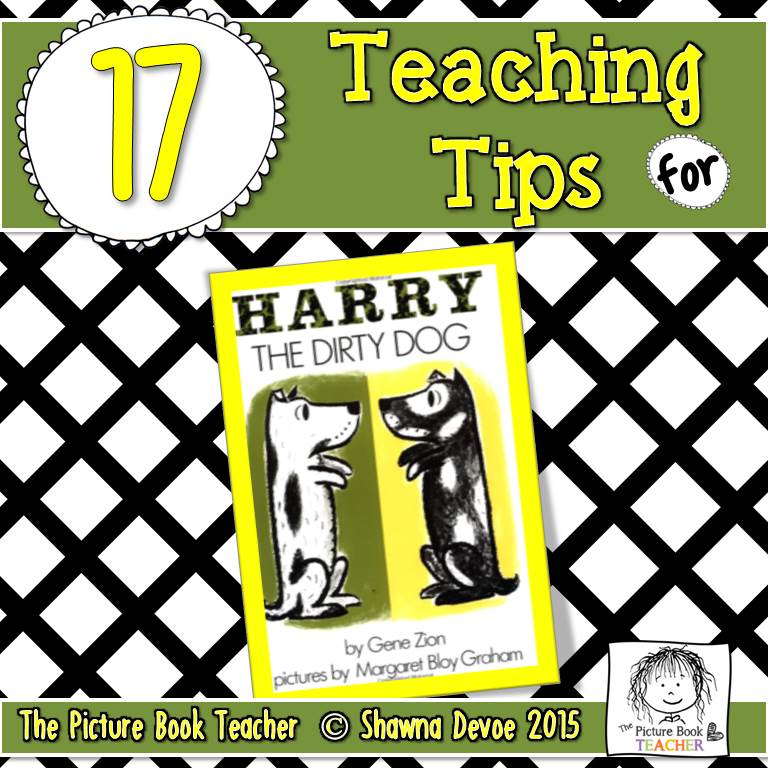
Harry The Dirty Dog by Gene Zion - Teaching Ideas


In 1956 when Gene Zion wrote this story, I am sure he had no idea that Harry The Dirty Dog would become such a classic. It is a story that every adult and {hopefully} every child has read or heard. I say hopefully because it is a book that can get lost in a book bin or overlooked when looking for that perfect read aloud. Well, I am here to tell you that you need to pull this little gem out and read it. You will be instantly transported back to a time when you were in school and either read this on your own or listened to your teacher read it aloud. My memories go straight back to the 1st grade when Mrs. Rand read it to our class {yes, I still remember her name and exactly what she looked like. I think she was about 100 years old when I had her}.  Well now, getting back to the story, it is a simple tale of a family with a dog that does not like baths. On the day of his bath Harry decides it would be better to run away than have that bath. He was right! He had fun traipsing through the city having all kinds of fun and getting extremely dirty. He was so dirty he was no longer white with black spots he is black with white spots!  Harry finally decides that he is tired and should head home, but a funny thing happened when he got there, his family didn't recognize him. What will Harry do to make his family recognize him? You will just have to read to find out what happens to poor ole' Harry {unless of course you remember the story, exactly!}?

To make this story more than just a read aloud, here is some more information about this book.


Reading level: 3.1
Theme: animals/pets
Genre: classics, animal stories

Suggested Vocabulary: coal chute, clever, flip-flopped, soundly

Reading skills and strategies:
  • asking questions - {before} Why are there two dogs on the cover? {during} Why did Harry not like taking a bath? How come Harry's family did not recognize him? How come Harry unburied the scrubbing brush? Why did Harry really want a bath? {after} Why did Harry hide the scrubbing brush again?
  • author's point of view - 3rd person
  • author's purpose - entertain
  • beginning, middle, end  - {beg} Harry hid the scrubbing brush so he wouldn't get a bath. Harry ran away. {mid} Harry played and got dirty as he wondered around the city. Harry got tired and wanted to go home. When Harry got home he was so dirty his family didn't recognize him. Harry did all the tricks he know but they still didn't recognize him. {end} Harry unburied the scrubbing brush and ran to the bathtub. The kids gave him a bath and discovered that it was Harry. Everyone was very happy.
  • cause and effect - Why did Harry hide the scrubbing brush? because he did not like to take baths. Why did Harry run away? because he did not want to take a bath. Why did Harry decide to go home? because he was tired. Why did the family not recognize Harry? because he was black with white spots instead of white with black spots. Why did Harry do all his tricks? because he tried to have the family recognize him. Why did Harry dig up the scrubbing brush? because he wanted a bath to show that he was really Harry.
  • characterization - describe Harry
  • compare & contrast  - compare and contrast Harry as a white dog and Harry as a black dog. How did he act? How did his family react?
  • connections - text-to-self - Have a white dog with black spots. Dog hates baths. Dog has run away. Dog came home. Dog got really dirty like Harry.
  • drawing conclusions - Why do you think Harry hid the scrubbing brush at the end of the story? {clues from the story} - Harry hid the brush at the beginning of the book because he didn't like baths {what I know} I know that even though Harry ran to the bath tub with the scrubbing brush to get a bath, he only did that because he wanted the family to see that he was a white dog not a black dog. {my conclusion} Harry still doesn't like baths and probably wont get that dirty again.
  • plot - character vs. self - Harry struggles with his dislike for baths and his needing to have a bath so that his family will recognize him so he can come home.
  • predict - How do you think Harry is going to get dirty? Is Harry going to go back home? Do you think somebody will find Harry? Do you think Harry's family is going to recognize Harry? What do you think Harry should do to be recognized? Will his family shoo him out of the yard? Will Harry like baths from now on? Do you think Harry will ever get as dirty as he just did again?
  • problem & solution - {problem} Harry didn't like to have baths and one day got so dirty that his family didn't recognize him. {solution} Harry unburied the scrubbing brush and ran to the bath tub so he could have a bath so his family could recognize him.
  • sequencing - Harry buried the scrubbing brush. Harry ran away. Harry got dirty. Harry got tired and went home. Harry's family saw a strange dog in their back yard. Harry did a bunch of tricks. The family did not recognize Harry. Harry unburied the scrubbing brush. Harry ran to the bathtub. The kids have Harry a bath. Everyone was happy. Harry put the scrubbing brush under his bed.
  • story elements - list title, characters, setting, theme, genre, problem and solution.
  • strong thought - students might have a strong thought when Harry decides to run away and when the family doesn't not recognize him.
  • summarize - {somebody}The family {wanted} wanted to give Harry a bath {but} but Harry buried the scrubbing brush and ran away {so} so he didn't have to have a bath. {then} Then Harry got tired and wanted to go home but his family didn't recognize him so {at the end} Harry finally unburied the scrubbing brush and ran to the bath tub for a bath so his family would recognize him.
  • visualize - all the places that Harry went when he ran away.

Here is a little freebie for you! To download just click on the picture.


If you would like more I have created a packet of activities to go with this book.


http://www.teacherspayteachers.com/Product/Activity-Packet-inspired-by-Harry-The-Dirty-Dog-by-Gene-Zion

Happy reading!

11